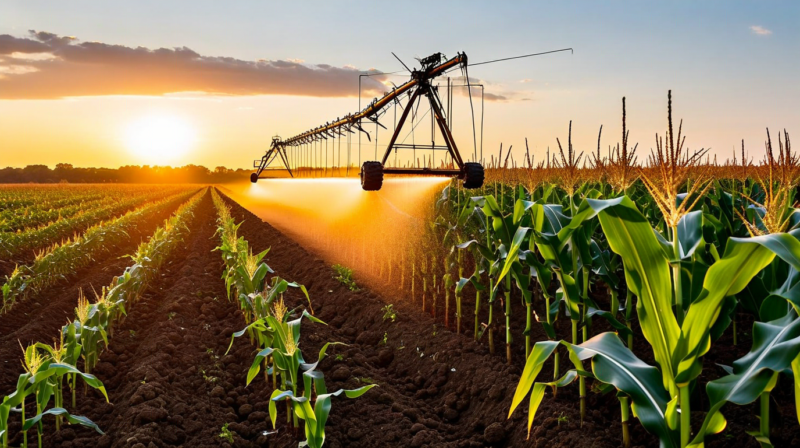
Management allowed depletion (MAD) is the fraction of total available water (TAW) that an irrigation system is designed to deplete before triggering an irrigation event. A MAD of 50 percent means you irrigate when the root zone has used half of its available water capacity. The 50 percent default has become the de facto starting point in most irrigation scheduling tools, largely because it is the value cited in widely read FAO and Nebraska Extension publications for corn under general conditions. The problem is that "general conditions" means the vegetative stage for average-stature hybrids, not the entire season. Using 50 percent MAD through pollination and grain fill is a known source of avoidable yield loss, and the magnitude depends on your soil's total available water and your irrigation system's ability to respond quickly to a trigger event.
What the FAO Publications Actually Say
FAO Irrigation and Drainage Paper 56 - the source most commonly cited for crop depletion thresholds - lists a depletion fraction (p) for corn of 0.55 under conditions of moderate evapotranspiration demand. This translates roughly to a MAD of 55 percent, not 50 percent, and it is explicitly noted as a baseline value for "average ET conditions" (approximately 5 mm/day). The paper includes a correction formula: for every millimeter per day that actual ET exceeds 5 mm, the depletion fraction decreases by 0.04. On a high-VPD day in Iowa when ETc reaches 8 to 9 mm/day during the R1 to R3 reproductive window, the corrected depletion fraction drops to 0.43 to 0.47. The practical implication: on your highest-demand days, MAD 50 percent is already too high according to the source most often used to justify it.
More critically, FAO 56 includes growth-stage-specific sensitivity coefficients (Ky) that quantify how a given level of water stress translates into yield loss. For corn during the reproductive period (approximately R1 through R3), Ky is 1.5 - meaning a 10 percent reduction in ETc below the crop's demand results in an expected 15 percent yield reduction. During the vegetative period (before V10), Ky is approximately 0.40, meaning the same water stress produces only 4 percent yield loss. Running MAD at 50 percent vegetatively is reasonable and water-efficient. Running it at the same threshold during grain fill ignores a three-to-four times greater sensitivity to stress at exactly the wrong time.
Trial Data from 2024 Iowa Plots
In 2024, we instrumented 12 trial plots in central Iowa with SDI-12 sensors at three depths and maintained four irrigation scheduling treatments: MAD 40 percent continuous, MAD 50 percent continuous, MAD 35 percent from R1 through R4 with MAD 55 percent otherwise (growth-stage variable), and no irrigation threshold (irrigation on calendar schedule at fixed intervals). All plots used the same hybrid (a popular 108-day CRM from a major seed company), same nitrogen rate, same plant population, and same seeding date.
Yield results at harvest showed the MAD 35-during-R1-through-R4 treatment outperforming the MAD 50 continuous treatment by an average of 11.4 bu/ac. The MAD 40 continuous treatment performed similarly to the variable MAD treatment, with a 0.6 bu/ac non-significant difference, but used 14 percent more total water over the season because it maintained a lower depletion threshold even during the vegetative stage when the crop can tolerate more depletion without yield penalty. The calendar schedule treatment underperformed all MAD-based approaches by 18.3 bu/ac on average, confirming that sensor-driven scheduling produces better outcomes than calendar-based approaches regardless of the specific threshold used.
Soil TAW and the Risk Window
The yield risk from a MAD threshold error is directly proportional to soil TAW and inversely related to irrigation system response speed. On a silt loam field with TAW of 180 mm per meter and a 0.90 m rooting depth at R2, total available water in the profile is approximately 162 mm. A MAD of 50 percent means you allow 81 mm of depletion before triggering irrigation. If your center pivot takes 72 hours to complete a pass and applies 25 mm per pass, you are comfortable: there is enough buffer between the trigger point and permanent wilting point for the system to respond before damaging stress occurs. On a sandier field with TAW of 100 mm per meter, the same MAD threshold allows only 45 mm before triggering, and the same 25 mm application on a 72-hour pivot cycle has substantially less margin for error. Tighter soils require tighter MAD thresholds during reproductive stages - often 30 to 35 percent on sands and loamy sands.
VPD Days and Demand Spikes
Vapor pressure deficit (VPD) is the driving force for transpiration: high VPD (warm, dry, windy air) pulls water out of the canopy faster than the root system and soil profile can replace it from the root zone. When VPD exceeds 3.5 kPa in corn at reproductive stages, ETc can reach 10 to 12 mm/day - two to three times the average summer daily demand. A soil profile that was 35 percent depleted at the start of a high-VPD day can reach 55 percent depletion by evening if the irrigation system does not respond. CropKern's scheduling algorithm increases effective MAD sensitivity (lowering the trigger threshold) when the 48-hour weather forecast shows VPD above 2.8 kPa and the current depletion is within 12 percent of the standard MAD threshold. This pre-emptive adjustment allows a pivot to start its cycle ahead of the high-demand window rather than in response to it.
How to Set MAD in CropKern for Corn
CropKern does not use a single fixed MAD value. The platform implements a growth-stage variable MAD schedule that transitions automatically based on GDD accumulation from planting. The default schedule for corn in the US Corn Belt is: MAD 55 percent from emergence through V6, MAD 50 percent from V7 through VT, MAD 38 percent from R1 through R3, MAD 45 percent from R4 through R5, and MAD 60 percent from R5.5 to black layer as the crop approaches physiological maturity and irrigation efficiency decreases. Agronomists can override any of these defaults on a per-parcel basis from the scheduling configuration panel.
For operations transitioning from a flat-rate MAD setting in another scheduling tool, the most important transition is adjusting the R1-through-R3 threshold. Moving from MAD 50 to MAD 38 during that window typically increases seasonal irrigation applications by 15 to 25 mm per parcel, but the yield gain in the 8 to 14 bu/ac range from our 2024 data provides a strong return on the additional water use in most operating contexts. In water-limited systems with well allocation constraints, the growth-stage variable approach also allows conservation during vegetative stages to preserve allocation for the higher-value reproductive stage, rather than applying uniform high-frequency irrigation throughout the season. Contact [email protected] to discuss how your water allocation and system capacity interact with optimal MAD scheduling for your specific setup.