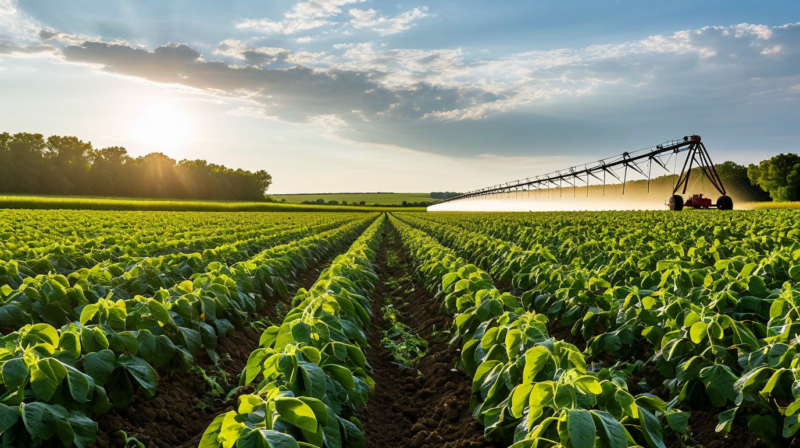
Many Corn Belt irrigators apply the same scheduling approach to soybeans as they use for corn - the same MAD thresholds, the same ET coefficient table, the same rooting depth assumptions. This is understandable: corn and soybeans are rotated on the same acres, often use the same pivot systems, and share many features of their water relationships. But the three most consequential scheduling differences between the two crops - critical stress window timing, maximum rooting depth development rate, and ET coefficient peak magnitude and duration - are different enough that applying corn parameters to soybeans introduces systematic errors that compound quietly into yield losses. This article covers each difference and the scheduling adjustments that correct for them.
Difference 1: Critical Stress Window Is Bloom-to-Pod Fill, Not Pollination
In corn, the single most yield-sensitive irrigation window is the two weeks around silking and pollen shed (VT through R2). Water deficit during this window directly reduces kernel set by disrupting pollen viability and silk receptivity. In soybeans, there is no analogous discrete pollination event. Soybean flowers are self-pollinated under the flower petals before the flower fully opens, making pollination itself largely drought-tolerant. The critical water-sensitive window in soybeans is instead the R1 (beginning bloom) through R6 (full seed) period, which spans approximately 45 to 55 days - a much longer window than corn's 14-day peak sensitivity.
The yield sensitivity driver in soybeans during R1-R6 is pod set and seed fill rate, not pollination. Water deficit during early pod set (R3) reduces pod count per plant - a yield component that cannot be recovered later in the season. Water deficit during seed fill (R5 through R6) reduces seed size and weight, directly lowering final yield per pod. Because the sensitive window is much longer than in corn, the water management strategy is different: instead of targeting intensive irrigation during a brief 14-day window, soybean scheduling requires sustained depletion management across a 6-to-8-week stretch, with the most intense management during R3 through R5 when seed size is being established.
In practice, this means that MAD for irrigated soybeans should be at 35 to 40 percent from R1 through R5 - stricter than the corn vegetative stage equivalent but without the extreme 30 to 35 percent threshold that is appropriate only during corn pollination. Applying the corn pollination-period MAD of 30 to 35 percent throughout the soybean R1-R6 window wastes water. Applying the corn vegetative-stage MAD of 50 to 55 percent through the soybean R3-R5 window risks yield loss. A sustained 38 to 40 percent MAD from R1 through R5, transitioning to 50 percent from R6 to harvest, is CropKern's default soybean scheduling profile.
Difference 2: Rooting Depth Development Is Slower Early, Deeper Late
Corn rooting depth development is rapid and relatively linear through the vegetative stage, reaching 0.9 to 1.2 m by VT. Soybean rooting depth development is slower in the early vegetative stages - soybeans prioritize taproot elongation before lateral root proliferation - but continues deeper through the reproductive stages, potentially reaching 1.2 to 1.5 m in well-structured, non-compacted soils by the R4-R5 period. This later, deeper rooting changes the effective available water buffer calculation over time in a way that differs from corn.
Using a fixed 0.9 m rooting depth for soybeans throughout the season understates available water buffer during R4 through R6 in deep-profiled soils. The plant can access moisture from below 0.9 m during pod fill, and an irrigation model that does not credit this access will trigger irrigation events that are not actually needed, wasting water and potentially over-saturating the upper profile. CropKern's soybean rooting depth model uses a GDD-from-emergence curve that reaches the initial 0.9 m depth at approximately R2 (the same timing as corn), then continues expanding at a reduced rate through R5, reaching 1.1 to 1.3 m in the model by seed fill depending on the soil series compaction resistance class assigned to the parcel. Agronomists can override the maximum rooting depth for specific parcels where soil limiting layers (plow pan at 0.7 m, gravel at 1.0 m) constrain rooting below the default maximum.
Difference 3: ET Coefficient Peak and Duration Differ from Corn
The FAO-56 crop coefficient for soybeans peaks at approximately 1.15 at full canopy (R1 to R3), similar to corn's 1.15 peak at mid-vegetative stage. The difference is in the shoulder of the curve. Soybeans maintain Kc above 1.0 from approximately V5 through R4 - a longer mid-season Kc plateau than corn's sharper peak and decline. Additionally, soybean canopy architecture (wider, more horizontal leaf angles than corn) creates a slightly higher Kc per unit LAI at the same LAI value due to higher aerodynamic resistance and boundary layer conductance from the broader leaf surface. The practical result is that soybeans have somewhat higher mid-season ET demand per unit leaf area than corn at comparable LAI values.
The CropKern ET model handles corn and soybean parcels with crop-specific Kc curves and spectral index thresholds for Kc adjustment. When crop type is set to soybean in parcel configuration, the Kc staging is automatically adjusted to the soybean curve. The most common error we see in new account setup is parcels defaulted to "corn" crop type when they are planted to soybeans, which applies the corn Kc peak at a different GDD staging than the soybean peak. For corn-soybean rotation operations, verifying and updating the crop type field for each parcel at the start of each growing season is a one-time annual task that significantly improves ET accuracy for the soybean year. Contact [email protected] to discuss setting up a rotation schedule that automatically flips crop type at the start of each planting season based on your historical rotation pattern.