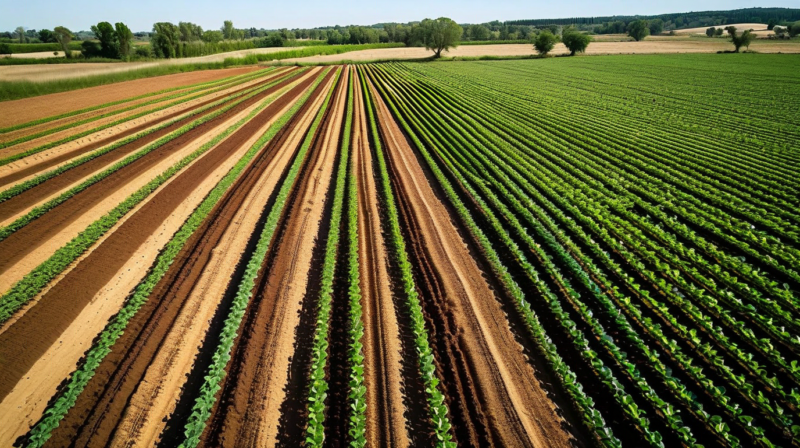
Uniform-rate irrigation - applying the same depth to every point of a center pivot's circle - is the dominant practice on the majority of irrigated row-crop acres in the Corn Belt. It is operationally simpler than variable-rate application and adequate for fields with homogeneous soils. But for fields with meaningful within-field soil texture variation, uniform irrigation creates a systematic inefficiency: zones with high water-holding capacity are frequently over-irrigated and may experience shallow rooting and denitrification losses, while zones with coarse textures are under-irrigated and experience periodic stress. Variable-rate irrigation (VRI) using management zones derived from historical yield maps and soil data can correct this pattern. This article describes the zone creation methodology used in CropKern and the results from a 2024 trial implementation across eight fields in central Iowa.
The Case Against Uniform Rate on Variable Soils
Consider a field with a 40-acre zone of Clarion loam (total available water approximately 2.0 in/ft) and a 30-acre zone of Dickenson sandy loam (total available water approximately 1.3 in/ft). A uniform pivot application of 1.0 inch adds the same application to both zones. In the Clarion zone, this brings the profile to approximately 60 percent recharge relative to field capacity - appropriate and efficient. In the Dickenson zone, the same 1.0 inch application brings the profile to 90 percent of field capacity and potentially past field capacity into drainage and runoff territory. The sandy zone does not need that application, and applying it wastes water, increases nitrate leaching risk below the root zone, and provides no yield benefit.
This within-field variation in water response is not unusual. In our 2024 trial field set, seven of the eight fields showed statistically significant zones with distinct water response characteristics based on yield map analysis. The outlier was a 160-acre field on relatively uniform Canisteo silty clay loam with less than 0.3 in/ft variation in TAW across the field - genuinely uniform enough that VRI would provide minimal benefit.
Zone Creation from Yield Maps
The zone creation process in CropKern begins with at least three years of post-processed yield maps (ideally five or more for stable zone boundaries). Yield maps are cleaned to remove headland passes, speed-related calibration artifacts, and GPS drift errors. The cleaned maps are resampled to a common 5 m grid and a temporal mean yield surface is calculated. This mean yield surface is then k-means clustered into three to five management zones. The number of zones is selected based on the within-cluster variance reduction curve - the point at which adding another zone provides less than 5 percent additional variance reduction is typically the appropriate stopping point.
The yield-map-derived zones are then compared against available soil data layers: SSURGO soil series boundaries, electrical conductivity (EC) mapping if available, and the satellite-derived soil bare reflectance index (a proxy for organic matter and soil moisture) from spring satellite passes when bare soil is visible. High concordance between yield zones and soil data layers increases confidence that the zones reflect stable soil properties rather than transient management effects. Low concordance (for example, a yield zone boundary that crosses SSURGO series boundaries and tracks a fertilizer application strip) flags a potential management artifact that should be investigated before committing the zone to a VRI prescription.
Assigning Variable-Rate Prescriptions
Once management zones are established, CropKern assigns zone-specific irrigation parameters: separate MAD thresholds, separate field capacity values, and separate application depths per trigger event. The low-TAW sandy zones receive a tighter MAD threshold (typically 30 to 35 percent versus 38 to 42 percent for the higher-TAW zones) to account for their smaller buffer, and smaller per-event application depths to prevent over-filling. The high-TAW zones receive larger per-event applications and slightly more liberal MAD thresholds, matching their soil's ability to store additional water without drainage losses.
The physical implementation requires a variable-rate drive system on the center pivot - a zone-control package from Valley, Lindsay, or T-L that allows the sprinkler bank to be modulated independently for different arc segments as the pivot rotates. The CropKern VRI prescription exports to the controller-specific VRI prescription format, which typically specifies the irrigation depth (as a percentage of the standard application depth) for each pivot angle segment. As discussed in our article on irrigation valve controller integration, the export process is automated once the pivot controller is integrated into CropKern.
2024 Trial Results: Water Use and Yield
The 2024 trial implementation across eight fields showed consistent results. Mean seasonal water application decreased by 18.3 percent compared to the prior three-year uniform-rate average on the same fields, with no statistically significant yield reduction at field scale. Zone-level analysis showed that the high-TAW zones (Clarion and Canisteo series) maintained yield equivalent to the uniform-rate historical average. Low-TAW zones showed an average 4.2 bu/ac yield increase, attributable to reduction of over-irrigation that had been causing shallow rooting and anaerobic conditions in wet years. In the 2024 growing season, which had above-average July rainfall, the water savings from not over-irrigating the high-TAW zones was particularly large: pivot run hours on those fields were 22 percent below the control fields still running uniform rates.
The water savings translate to direct operating cost reduction for operations on metered water systems or with well pumping costs. At typical Corn Belt electricity costs for center pivot pumping (approximately $0.09 to $0.14 per kWh), a 20 percent reduction in pivot run hours on a 160-acre circle reduces seasonal pumping cost by $300 to $600 per field depending on lift height and system efficiency. For an operation with 1,000 irrigated acres across multiple fields, the aggregate annual savings in the range of $2,000 to $4,000 from VRI water reduction is a meaningful contribution to the platform's payback calculation.
Limitations and When VRI Is Not the Right Investment
Variable-rate irrigation provides its largest benefit when within-field soil TAW variation exceeds approximately 0.5 in/ft between zones, when the zones are large enough (generally over 15 acres) to be practically managed as separate irrigation units, and when the operation already has multi-year clean yield map data to create stable zone boundaries. For fields with homogeneous soils, small parcels below 80 acres, or limited yield map history, the zone creation methodology will either not find meaningful zones or will create unstable zone boundaries that change significantly from year to year. In those cases, the investment in a VRI drive system is not justified by the precision benefit, and uniform irrigation with well-calibrated MAD scheduling is the more efficient approach. Contact the CropKern team at [email protected] to request a VRI feasibility assessment for your specific fields based on your yield map history and SSURGO soil data.